
- Real price range: Production AI receptionists run $497 to $1,997+ per month in 2026. Anything below $200 is usually a shared template. Above that, the price scales with how much of the revenue system (website, CRM, ads, reputation) is built around the voice, not just the phone line.
- What drives cost up: Voice quality (Gemini Live 3.1 vs older cascade models), integration depth (ServiceTitan two-way sync vs a Google Sheet drop), custom prompt training, owner-mode features, and multi-location routing.
- What's actually included: 24/7 answering, live appointment booking into your CRM, SMS confirmation, sentiment-based escalation to a human, and call recordings or transcripts. Setup fees range from $997 to $3,197 depending on complexity.
- ROI math: One captured after-hours service call usually pays for the entire month. The break-even for an HVAC business is roughly one job per month, every month after that is upside.
AI receptionist cost is the first thing every home service contractor wants pinned down before signing up. The short answer: a production-grade AI receptionist for a home service contractor runs $497 to $1,997+ per month in 2026, with setup fees ranging from $997 for the entry tier up to $3,197 for a fully custom deployment. That is the honest range. Anything cheaper is usually a shared template with limited customization. The higher tiers cost more because they bundle a full revenue system (website, CRM, ad infrastructure, and reputation) around the voice, not because you are paying for an in-house engineering team you do not need.
This post breaks down what is behind those numbers, what you actually get at each price tier, how AI compares to hiring a receptionist or using a human answering service, and the ROI math that determines whether the spend makes sense for your business. Most of what follows is grounded in what we charge to deploy Sara, the DFS AI receptionist that answers, qualifies, and books appointments live for HVAC, plumbing, restoration, and pest control businesses.
What does an AI receptionist actually cost?
Pricing in this space settled into three real tiers over the last 18 months. The labels vary by vendor, but the underlying structure is the same. Here is what each tier typically includes, using DFS pricing as the reference point.
Lead Capture, $497 per month
The entry tier covers the AI voice itself, a 5-page professional website, basic CRM sync (usually GoHighLevel or Google Calendar), call recordings, SMS confirmation and missed-call text-back, and a standard call-minute allotment that comfortably covers most single-location small businesses. The prompt is templated for your industry but customized for your business name, hours, and service area. This is the right tier for a solo operator or a smaller home service business that wants 24/7 coverage without a full custom build. Setup is $997.
Revenue Recovery System, $797 per month
The tier most clients start with. On top of everything in Lead Capture, you get a full custom website with hyper-local pages you own for life, Sara on phone, voice widget, and chat, a client portal (projects, invoices, messages, voice recordings, website monitoring), NeurQon CRM access (contacts, pipeline, conversations), unlimited minutes, a 90-day email nurture sequence, and a database reactivation campaign that re-engages your past customers with no new ad spend. This is the most common tier for established home service businesses. You get the polish of a custom build without the price tag of one. Setup is $1,997.
Market Domination, $1,997 per month
This is where the receptionist stops being a phone line and becomes a full revenue system. On top of everything in Revenue Recovery, you get full technical and on-page SEO, 6 hyper-local blog posts per month, priority support, and a quarterly strategy review, all feeding the same AI voice that answers, qualifies, and books. This is the right tier for established operators who want one system capturing and converting every lead and owning their local market, not just answering the phone. Setup is $3,197. It is the same system behind our HVAC Revenue Recovery System.
If a vendor is quoting you under $200 per month, look closely. Either the voice quality is poor (older cascade STT + TTS stitched together, not Gemini Live or similar), or the integrations are shallow (just a webhook drop, no two-way sync), or both. Real production AI on modern voice models costs real money to run, the math does not work below that threshold.
What's included at each price tier?
The price tag does not tell you much on its own. Here is what should actually be in the box at each level. If a vendor is missing items from the Lead Capture column, walk away.
| Feature | Lead Capture ($497) | Revenue Recovery ($797) | Market Domination ($1,997) |
|---|---|---|---|
| Modern voice model (Gemini Live 3.1 or equivalent) | Yes | Yes | Yes |
| 24/7 answering, no hold music | Yes | Yes | Yes |
| Live appointment booking into CRM | Yes | Yes | Yes |
| SMS confirmation and missed-call text-back | Yes | Yes | Yes |
| Call recordings and transcripts | Yes | Yes | Yes |
| Website | 5-page professional site | Full custom + hyper-local pages | Full custom + hyper-local pages |
| Sara on phone, voice widget, and chat | Phone + widget | Phone, widget, and chat | Phone, widget, and chat |
| Client portal (projects, invoices, messages, recordings) | No | Yes | Yes |
| NeurQon CRM access (contacts, pipeline, conversations) | No | Yes | Yes |
| Included call minutes | Standard allotment | Unlimited | Unlimited |
| 90-day email nurture sequence | No | Yes | Yes |
| Database reactivation campaign | No | Yes | Yes |
| Full technical and on-page SEO | No | No | Yes |
| Monthly hyper-local blog content | No | No | 6 posts/month |
| Support response time | Email, 1-2 days | Same-day | Priority, dedicated contact |
For a deeper dive into the capability surface across tiers, see what an AI receptionist can actually do and the honest list of where the technology still struggles.
Are there setup fees?
Yes, and any vendor claiming otherwise is hiding the cost somewhere else. Real setup fees in 2026 range from $997 for the entry tier up to $3,197 for a fully custom revenue-system build. Most mid-tier setups land around $1,997. Multi-location and franchise rollouts are quoted separately on top of that.
Here is what setup actually covers, and why it costs what it costs:
- $997 setup (Lead Capture): 5-page professional website, business name and hours configured, GoHighLevel or Google Calendar wired up, prompt templated to your industry, basic test calls. Good fit for a solo operator getting started.
- $1,997 setup (Revenue Recovery System): Full custom website with hyper-local pages, custom prompt training, GHL pipeline build, two-way CRM sync, client portal provisioning, NeurQon CRM onboarding, service-area filtering, ZIP allowlists, SMS templates, dispatcher notifications, 90-day nurture sequence, database reactivation campaign, and a phone number provisioned with proper carrier setup (A2P 10DLC, STIR/SHAKEN, CNAM).
- $3,197 setup (Market Domination): Everything above plus full technical and on-page SEO buildout, monthly hyper-local content engine, custom voice profile, after-hours emergency dispatch rules, and white-glove onboarding with your team.
A note on honesty: at DFS, the website we build for you stays at cancellation. The AI receptionist, the automations, and the portal access get unplugged. That matters because some vendors imply everything is yours forever, which is not how SaaS economics work. The setup fee is real, the monthly fee is real, and what you keep at the end is the asset (your website, your domain, your data exports), not the running infrastructure.
How does it compare to alternatives?
The pricing only makes sense when you put it next to what you would otherwise spend. Here is the real 2026 cost stack for the inbound call layer.
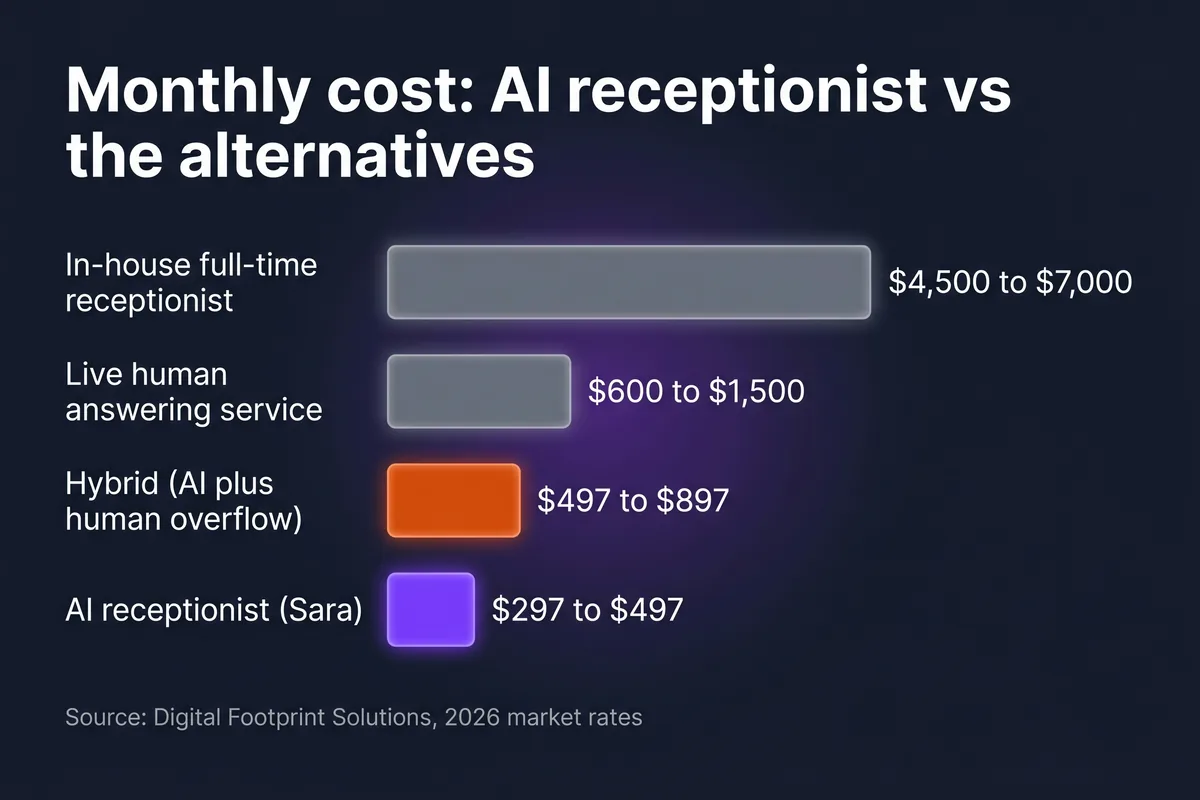
| Option | Monthly Cost | Coverage | CRM Writes |
|---|---|---|---|
| In-house full-time receptionist | $4,500 to $7,000 | 40 hrs/week, business hours only | Yes, manual |
| Human answering service | $600 to $1,500 | 24/7 with limits | Rarely, usually email or SMS forward |
| Hybrid (AI primary + human escalation) | $497 to $897 | 24/7 | Yes, automated + manual |
| AI receptionist | $497 to $1,997+ | 24/7 | Yes, automated and live |
The in-house option looks expensive because it is. $4,500 is the lowest end before benefits and payroll taxes, and that gets you one person working 40 hours per week. Nights, weekends, sick days, and vacations are uncovered unless you hire a second person.
Human answering services are cheaper but the trade-off is data quality. Most do not write to your CRM, so you get an email or SMS forward and your team has to manually re-enter every lead. That handoff is where leads die. For a side-by-side on the workflow differences, see AI receptionist vs virtual receptionist.
AI receptionists are the cheapest and most consistent option for the inbound call layer specifically. The hybrid model is the right call when you have call volume that justifies a human on standby (high-end remodelers, restoration companies dealing with insurance carriers), but most home service businesses do not need it.
What's the actual ROI math?
The pricing question only matters if the AI captures more revenue than it costs. Run the math for your business and the answer is usually obvious.
Here is a real example for an HVAC business doing $2M in annual revenue:
- Average service ticket: $450
- Missed-call rate before AI: 22 percent of inbound calls (industry average for businesses without 24/7 coverage)
- Monthly inbound call volume: 280 calls
- Calls that would have been missed: 62 per month
- Recovery rate with AI (calls that book vs. hang up): 35 percent
- Recovered bookings per month: 22
- Close rate on recovered bookings: 45 percent
- Net new jobs per month from AI: 10
- Net new revenue per month: $4,500
- AI cost (Lead Capture tier): $497
- Net contribution: $4,151 per month, $49,812 per year
The math is even stronger for verticals where the ticket size is bigger. A restoration company recovering a single Category 2 water loss covers the AI cost for a year. A roofer winning a single storm-surge job covers it for two. Run the calc honestly on your own numbers and the threshold is usually trivial.
What makes some AI receptionists more expensive than others?
If you have shopped this space at all you have seen pricing from $79 to $1,500 per month for what is nominally the same product. Here is what is actually different.
Voice quality
The biggest cost driver. Modern voice models like Gemini Live 3.1 are conversational, with natural pauses, back-channeling, and barge-in (the AI stops talking when you start). The cheaper end of the market is still running cascade systems (separate speech-to-text, then a text LLM, then text-to-speech) which sounds robotic and has 1.5 to 3 second latency between turns. Callers can hear the difference inside 10 seconds, and so can you on a demo.
Integration depth
"Sends leads to your CRM" can mean two very different things. A real integration writes the appointment directly into ServiceTitan, holds the slot, and fires SMS confirmation, all while the caller is on the line. A cheap integration drops the call summary into a Google Sheet or sends an email to dispatch. The first one closes deals. The second one creates more manual work.
Custom training
A generic template will book appointments. A prompt tuned to your specific intake script (your service-type routing, your ZIP allowlist, your emergency-vs-scheduled triage, your franchise-specific scripts) will book the right kind of appointments. The difference shows up in close rate, not booking rate.
Owner-mode and personal-assistant features
The top tier of AI receptionists now includes owner-mode (passphrase-gated access for the business owner) that exposes personal-assistant tools, calendar lookup, contact search, voice notes, SMS-on-your-behalf. This stuff costs real engineering time to build right (authentication, contact disambiguation, fact-checking against your CRM in real time), which is why it lives in the top tier.
Reliability and support
Production AI receptionists need a real on-call rotation, server-side validators, anti-hallucination guards, and stuck-session watchdogs. Vendors who skip those steps will quote you cheap and then disappear when something breaks at 2am on a Saturday. For a full breakdown of what setup actually involves, see how to set up an AI receptionist for your business.
Common questions about AI receptionist pricing
How much does an AI receptionist cost per month?
Production AI receptionists for home service contractors run between $497 and $1,997 per month in 2026. Lead Capture tiers around $497 cover the AI voice, a professional website, basic CRM sync, and standard call volume. Revenue Recovery tiers around $797 add a full custom website, a client portal, NeurQon CRM access, and a database reactivation campaign. Market Domination tiers from $1,997 add full SEO, monthly content, and a complete revenue system (website, CRM, ad infrastructure, and reputation) built around the voice. Pricing under $200 usually means a shared template with limited customization. Above that, what you pay scales with how much of that revenue system is bundled in, not just the phone line.
Are there setup fees for an AI receptionist?
Yes. Setup fees are real and range from $997 for a Lead Capture deployment to $3,197 for a full Market Domination build with CRM migration, SEO, and bespoke voice training. Be skeptical of any vendor that claims zero setup fees, that usually means corners were cut on integrations, voice quality, or onboarding. A typical mid-tier setup at DFS lands around $1,997 depending on integration depth.
Is an AI receptionist cheaper than hiring a receptionist?
Substantially. A full-time in-house receptionist costs $4,500 to $7,000 per month all-in (salary, payroll taxes, benefits, equipment). A human answering service runs $600 to $1,500 per month for limited hours and no CRM writes. An AI receptionist runs $497 to $1,997+ per month, works 24/7, never calls in sick, and writes directly to your CRM. The math gets even stronger when you include captured after-hours calls a human receptionist would have missed entirely.
What drives the price of an AI receptionist up?
Five things drive cost up: voice quality (Gemini Live 3.1 and the top-tier voice models cost more per minute than older cascade systems), integration depth (writing to ServiceTitan with two-way sync costs more than dropping leads into a Google Sheet), custom training (a prompt tuned for your specific intake script costs more than a generic template), owner-mode features (passphrase-gated access to your calendar, contacts, and reminders), and multi-location or multi-line routing across teams.
Does an AI receptionist charge per call or per minute?
Most production AI receptionists charge a flat monthly fee with included call minutes, then bill overage past a threshold. DFS bundles enough minutes into each tier that the average HVAC, plumbing, or pest control business never hits overage. Avoid pure per-minute billing for inbound calls, it punishes you for the calls you actually wanted to capture. Per-call pricing is fine for outbound campaigns, less fine for your main business line.
See pricing on a real demo
15 minutes. We show you the tier that fits your business, walk through what's included, and let Sara book a live appointment so you can hear it before you commit. No slide deck, no fluff.
Book a 15-min demo →
