- The core trade-off: AI gives you instant pickup, unlimited concurrent calls, and a flat monthly bill. A human virtual receptionist gives you empathy, judgment, and the ability to handle anything weird without escalation.
- Where AI wins: high call volume, peak-season surge, after-hours, multi-trade routing, and any contractor who cares about answering every single call.
- Where a human virtual receptionist wins: high-empathy verticals, lower call volume, niche industries with complex intake, and owners whose brand leans on the human touch.
- The hybrid answer: most contractors over 3 million dollars in revenue end up running AI as first touch with a human virtual receptionist on overflow. You get scale plus a safety net without paying full human prices on every call.
AI receptionist vs virtual receptionist comes down to four trade-offs: speed, cost, scale, and the kind of empathy a customer wants when something has gone wrong. A virtual receptionist is a remote human who answers your phone from a call center. An AI receptionist is software that answers, qualifies, and books appointments using a voice model. Both replace the in-house front desk you do not want to hire for; one uses people, the other uses code.
This is the honest comparison. Where AI wins, where humans still win, and the hybrid setup most home service contractors land on once they cross 3 million in revenue. Most of what follows comes from running Sara, the AI receptionist Digital Footprint Solutions deploys for HVAC, plumbing, restoration, and pest control businesses, alongside clients who layer in human virtual receptionist services like Ruby or Smith.ai for escalations. If you are just starting and want to know whether AI can book a call at all, start with our pillar guide on whether AI receptionists can schedule appointments.
What is a virtual receptionist?
A virtual receptionist is a human at a remote call center who answers your phone for you. The call forwards to the service, a trained receptionist picks up using your script, captures the caller's info, and either books an appointment, takes a message, or transfers to you. Same job as an in-house receptionist, just outsourced and shared across businesses.
The main players: Ruby Receptionists, Smith.ai, AnswerConnect, Davinci, Posh, Abby Connect. Pricing is per minute (1 to 3 dollars) or monthly bundles (200 to 600 dollars at entry tier, higher for full-time coverage). Most plans cap minutes, and overage charges are not friendly.
What you get from a human virtual receptionist:
- A real person who can think on their feet.
- Genuine warmth and empathy on hard calls (a flooded basement, a furnace out in January, a billing dispute).
- The ability to handle anything the script does not cover.
- A brand voice that feels distinctly human, which still matters for some businesses.
What you give up:
- Speed: human pickup averages 30 to 90 seconds.
- Concurrency: most plans let one or two callers through at a time before the rest go to voicemail.
- Coverage: 24/7 plans cost more, sometimes a lot more.
- Direct CRM integration: most services drop a message into your inbox or text you the details. Real-time write-back to GoHighLevel or ServiceTitan is rare and usually requires custom work.
What is an AI receptionist?
An AI receptionist is software that picks up your phone, talks to the caller in natural language, and does the same job a human receptionist does, except 24/7 with no scheduling, no sick days, and no concurrency cap. The voice models in production today (Gemini Live 3.1 Flash, the model powering Sara, is one example) are conversational enough that most callers ask "are you the new girl in the office?" more often than they ask "is this a robot?"
A modern AI receptionist does five things in a normal call:
- Picks up inside three rings, greets in the owner's brand voice.
- Classifies intent (new appointment, reschedule, quote, emergency, general question).
- Qualifies the lead and captures contact details and service address.
- Checks calendar availability in real time and books a slot directly into your CRM.
- Fires an SMS confirmation and notifies the dispatcher.
The whole exchange averages 60 to 120 seconds. For the full breakdown of what AI receptionists can and cannot do, see what an AI receptionist can actually do (and what it can't).
Pricing is typically a flat monthly fee that includes unlimited inbound calls, with one-time setup to configure the prompt, integrate the CRM, and provision the phone number. Detailed numbers live in our 2026 cost breakdown.
Side-by-side comparison
Here is the honest version of the same table every vendor publishes, except this one is not stacked.
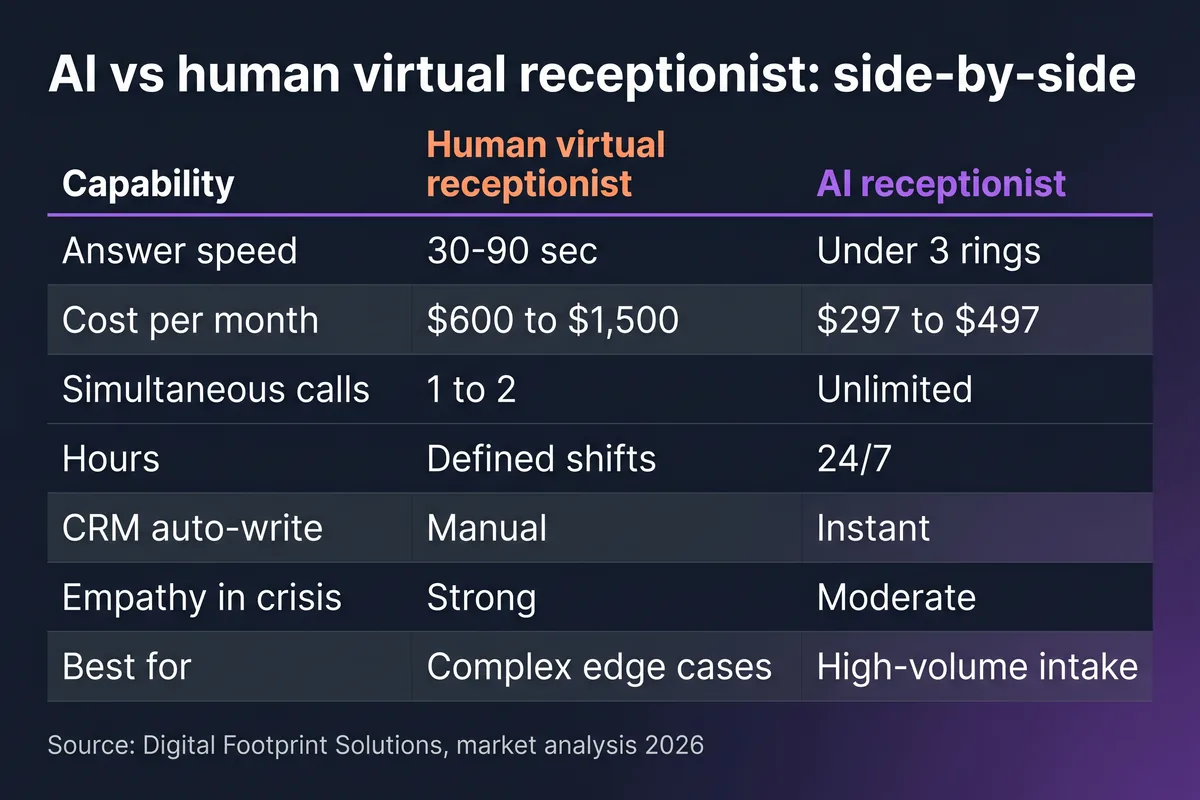
- Answer speed: AI picks up inside 3 rings, every time. Human virtual receptionists average 30 to 90 seconds.
- Monthly cost (moderate volume): AI typically runs a flat fee covering unlimited calls. Human services run 200 to 600 dollars per month at entry tier, more at higher volume, with overage charges.
- Simultaneous calls: AI handles unlimited concurrent calls. Human services usually handle 1 to 3 at a time before callers hit voicemail.
- Hours: AI is 24/7 by default. Human 24/7 coverage costs significantly more.
- CRM auto-write: AI writes appointments live into GoHighLevel, ServiceTitan, Google Calendar, etc. Human services usually email or text you the details and you (or your CRM automation) handle entry.
- Empathy in a crisis: A trained human still wins here. AI is improving fast but cannot match a calm voice walking a panicked homeowner through a flood.
- Best for: AI for high-volume contractors who want every call answered; human for low-volume, high-empathy, or brand-driven shops.
When does a virtual (human) receptionist beat AI?
I run an AI receptionist company and I am still going to give human virtual receptionists a fair shake here, because they are genuinely the right answer for some businesses.
- High-empathy verticals. Hospice care, funeral services, grief counseling, certain therapy practices. The first 10 seconds of those calls require a human voice that can hold space. AI is getting closer here, but for now, a human still wins.
- Niche industries with weird intake. If your call flow involves a 30-minute medical history, a multi-page legal intake, or anything where the receptionist needs to interpret what they are hearing on the fly, a human is going to outperform a script-bound AI for a while.
- Low call volume. If you get 5 to 10 calls a week, a per-minute human service might cost less than an AI subscription. The flat-rate AI economics only crush human pricing once volume is real (think 30 plus calls a week).
- Brand voice that leans human. Some boutique businesses (high-end home builders, concierge service brands, white-glove anything) have a brand promise that says "you talk to a person who cares, every time." For them, the human is the product, not a cost center.
If any of those describe your business, AI might not be the right first move. Or it might be the right second move (see hybrid below).
When does AI beat a virtual receptionist?
For the typical home service contractor (HVAC, plumbing, roofing, restoration, pest control, electrical, remodeling), AI usually wins on the math and on the customer experience. Here is where the gap shows up.
- High call volume. If you are taking 50 or more calls per week, AI flat-rate pricing destroys per-minute human pricing. A busy HVAC shop in peak summer can easily hit 200 calls a day. Try paying 1.50 per minute for that.
- Peak-season surge. A heat wave drops on your area and you get 4x normal call volume in 48 hours. AI absorbs it without breaking. A human virtual receptionist service either drops calls, makes callers wait, or charges overage.
- After-hours and weekends. AI runs 24/7 at the same flat rate. Human 24/7 coverage is a separate (more expensive) plan.
- Multi-trade routing. If you run HVAC, plumbing, and electrical under one roof, AI can route the call to the right pipeline, calendar, and technician based on what the caller says. Humans can do this too, but you need a really well-trained receptionist who knows your business cold.
- Every call answered. A missed call in this industry is a 250 to 1,500 dollar lost job. AI never misses. Humans miss when concurrent calls overlap or when they are on a break.
- Live CRM write-back. AI writes the appointment into GoHighLevel, Google Calendar, ServiceTitan, etc., in real time, with phone normalization, address validation, and slot deduplication on the server side. That last 15 percent of accuracy is what separates a 95-percent-accurate production system from a chatty demo. For the gory engineering details, see the real limitations of AI receptionists.
For a plumber who runs emergency dispatch, after-hours overflow alone usually pays for the AI in the first month.
What about a hybrid setup?
This is where most contractors over 3 million in revenue end up. The math just works.
The setup looks like this. AI is the first touch on every inbound call. It answers in under 3 rings, qualifies the lead, books the appointment, and writes it into the CRM. On the specific calls where AI is the wrong fit (a crying customer, a complex multi-job request, a legal question, an irate caller, anything where the AI hits an escalation trigger), the call routes to a human, either an in-house staffer or a virtual receptionist service on overflow.
You get the scale and cost economics of AI on the 80 to 90 percent of calls that are normal booking conversations, and you get the human safety net on the 10 to 20 percent of calls that actually need one. It is the same logic as a hospital using a triage nurse before a specialist: don't burn your highest-cost resource on the lowest-complexity work.
Setting up the hybrid is not complicated. The AI handles the call, hits an escalation trigger, and warm-transfers via SIP to a forwarding number that rings your virtual receptionist provider or an in-house team. If you want the build playbook, our setup guide for AI receptionists walks through the configuration, including escalation routing.
Common questions about AI vs virtual receptionists
What's the difference between an AI receptionist and a virtual receptionist?
A virtual receptionist is a remote human who answers your phone from a call center, usually billed per minute or per month. An AI receptionist is software that answers, qualifies, and books appointments using a voice model. Both replace an in-house front desk; one uses people, the other uses code.
Is an AI receptionist cheaper than a virtual receptionist?
Usually yes, especially at volume. Virtual receptionist services charge around 1 to 3 dollars per minute or 200 to 600 dollars per month for a modest plan. An AI receptionist typically runs a flat monthly fee that covers unlimited calls, so the more volume you have, the bigger the cost gap.
Can an AI receptionist handle emergencies like a human can?
Yes for triage and dispatch, with a caveat. A modern AI receptionist can detect emergency keywords, route the call to an on-call technician, and capture all the intake details a human would. Where a human still wins is empathy on a distressed call, like a homeowner with active flooding. A good setup escalates those calls to a person instead of pretending.
Will customers know they're talking to an AI?
Most do not, at least not at first. Modern AI voice quality is conversational with natural pauses. Many callers assume they are speaking to a new staff member. Disclosure is a brand choice, not a technical requirement; both approaches work as long as the experience is professional and the appointment actually books.
Should I use both AI and a human receptionist?
For most contractors doing 3 million dollars or more in revenue, a hybrid setup is the right answer. AI handles the high-volume first touch (booking, qualification, after-hours), and humans handle escalations, complex reschedules, and high-empathy calls. You get scale plus a human safety net without paying full human prices on every call.
Hear AI side-by-side with a human
15 minutes. We put Sara on a live call and you decide for yourself whether you can tell the difference. No slide deck, no fluff.
Book a 15-min demo →
